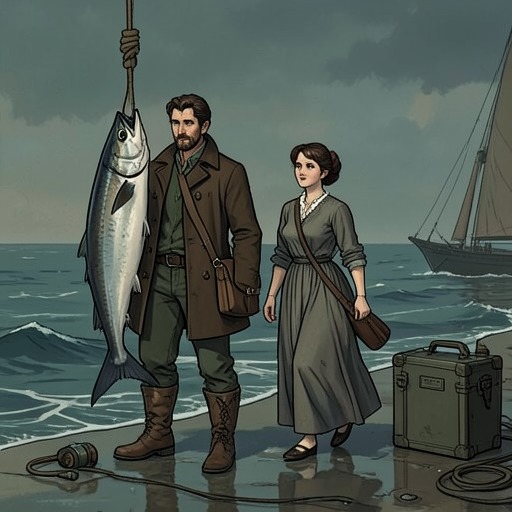
Tanna Goff
Washington BlackTanna Goff is an unconventional artist and marine naturalist whose frankness unsettles the social roles expected of her, and whose relationship with Washington Black becomes both intimate and creative. Born in the Solomon Islands and living on the Nova Scotia coast, she seeks room to draw, study the sea, and move on her own terms. She and Washington fall in love and help develop Ocean House, a permanent aquatic exhibition in London, but its success also makes visible the unequal conditions under which their contributions can be recognized.
Identity and Background
Washington first notices Tanna as a small, short-haired figure in an oversized man’s hat and beige trousers rolled to the knees. Her plaster-cast left hand is stained with soot, her other hand with paint; she gestures toward the anemones drying beside his easel and jokes that her own reproductions look rather less like marine life. She is direct about her shortcomings as an artist and asks him to teach her. Her clothing initially leads Washington to assume she is a man, but her appearance resists easy classification: she is short and doll-like in stature, yet speaks with confidence and an incisive intelligence that make her seem neither childlike nor vulnerable.
Tanna introduces herself after realizing that she and Washington have been sketching beside one another each morning for two weeks without speaking. She is amused by his politeness and explains that she thought it was time they became acquainted. Washington is struck by her golden skin, freckles, and flinty, intelligent eyes, and cannot place her neatly within the racial categories he has learned to expect. Her own brief account supplies a few firm points of history: she was born in the Solomon Islands, has five older half-brothers, and lost her mother in childbirth. She does not explain how she came to the isolated Nova Scotia shore. Her broken wrist, which she says has set back her drawing, frustrates her because she knows the sea creatures intimately but wants to improve her ability to depict them.
Life and Work on the Nova Scotia Coast
The shoreline becomes the setting in which Tanna and Washington gradually know one another. She has been coming there early to paint the tide pools, often working beside him without either of them realizing how close they have become. Their shared practice is attentive and physical: they wade into the water, and Washington points out crabs, fish, limpets, slugs, worms, and starfish while Tanna studies them closely. Her curiosity is not limited to the act of looking. She knows the whelks as intimately as she knows her own voice, and wants to acquire the artistry to render them.
Her father, G. M. Goff, learns that she has been leaving the house early and insists on accompanying her for safety. Tanna would rather remain at home than surrender her freedom in this way. When Washington joins G. M. Goff and Tanna on a boat outing, G. M. Goff explains that his daughter had been trying to paint the tide pools and had objected to having her liberty compromised. The scene makes the conflict plain: her father may protect her, but his protection also restricts the independent work she values. Tanna’s determination to leave the house and pursue her own practice is therefore not a casual preference; it is a repeated negotiation over who can decide where she goes and what she does.
Tanna is also sharply alert to Washington’s history and to the limits imposed on him. In a difficult exchange, she tells him that he is strong, self-sufficient, and has made a life after hardship. Washington objects that her words risk treating slavery as a matter of temperament, as if some people were naturally suited to enslavement and others could simply overcome it through mettle. He insists that slavery is a savagery, not a test of character. Tanna flushes and says he has misunderstood her meaning. Their argument exposes a real difference in perspective: her praise of his strength cannot erase the coercion that made his circumstances, and he refuses to let personal resilience stand in for justice.
Relationship with Washington Black
At first their connection is built from repeated mornings, shared observation, and the slow recognition that the other is already part of the daily landscape. Tanna reaches for Washington’s hand while asking him to teach her to draw. He flinches at the touch but does not pull away. The moment awakens an unfamiliar openness in him: seeing desire plainly returned on her face gives him a sense of physical wholeness and of being a man intact. When Tanna notices the scar on his cheek and asks how he got it, intimacy meets the history written on his body. Washington wants to move closer, then recoils in terror and releases her hand.
Their relationship does not proceed as a simple passage from attraction to ease. Tanna’s frankness can unsettle Washington, particularly when she speaks about freedom and self-sufficiency in terms that seem to understate the force of enslavement. Yet she also meets him without the condescension he fears: she approaches him as an artist whose skill she wants to learn and as a person whose thoughts merit an answer. Their connection deepens into a love affair. At one point Tanna steps forward, looks boldly at him, and unfastens her gown; the scene makes her desire an act of her own decision rather than a response Washington has presumed for her.
Tanna’s relation to Washington is bound up with the pressures within her family. G. M. Goff invites Washington to accompany him and Tanna on a boat trip, explaining that he and his daughter are isolated and could use kindred company. When Washington arrives, Tanna is angry and does not greet him, while her father speaks for her and calls her his daughter. During the outing she eventually says that G. M. Goff is collecting New World specimens for a small exhibition in London. In the boat, she holds a crab in her good hand and, after meeting Washington’s gaze, gently returns it to the sea. Her restrained gesture and her refusal to participate in her father’s talk give the moment a quiet counterpoint: she can share the work of observation while remaining wary of the arrangements through which her father manages it.
Ocean House and the Question of Credit
Washington proposes turning G. M. Goff’s planned exhibition into a living one: a large hall with tanks of aquatic life, open-air terrariums for creatures such as toads, turtles, and lizards, and visitors close enough to press their faces to the glass and observe the animals’ habits firsthand. Tanna immediately names the vision a menagerie of the sea. The proposal becomes Ocean House, a permanent aquatic exhibition in London. After G. M. Goff presents the idea to the Zoological Committee, the committee accepts it enthusiastically, offers land in the zoological gardens, and allows an old timber building to be repurposed; if the work proceeds quickly, the doors may open to the public the following year.
For Washington, Ocean House is the first creation that feels like his own. He contrasts it with the Cloud-cutter, which he helped make but regards as Titch’s vision. The new exhibition grows from his idea, calculations, and labor, yet he expects that the public history of the place will name G. M. Goff, not a disfigured Black teenager without formal scientific training, as its father. Washington understands that the committee might not see him as an equal if he approached it himself. G. M. Goff is not presented as simply malicious: Washington believes he does not like to take credit for Washington’s discoveries in principle, but also recognizes the older man’s desire to make a late sensation and the power imbalance that makes Washington’s own authorship difficult to claim.
Tanna is part of the world of work that makes the exhibition possible, but the evidence does not establish that she receives public recognition for the project either. As the collection develops, Washington takes pride in the place and in its capacity to reveal the beauty of creatures people might otherwise find nightmarish. He also sees how much of his own hand is present in the tanks’ size and materials, the choice of specimens, and the arrangement of aquatic plants. He sweats through mistakes and late nights, yet his name is nowhere. The tension between the exhibition’s promise of closer, more informed attention and the concealment of its maker’s contribution shadows the work shared by the Goffs and Washington.
Change and Narrative Significance
Tanna’s character is shaped by the collision between her appetite for independent work and the protections and expectations imposed by her father. She has already chosen to leave the house for the tide pools, even when G. M. Goff’s supervision threatens to undo that freedom. Her choice to approach Washington, ask for instruction, and make their attraction explicit likewise gives her an active part in the relationship rather than casting her as merely its object. At the same time, the story offers no simple resolution of her independence: her father remains a central figure in the plans that take the marine work from the Nova Scotia shore to London.
Her birthplace, uncertain journey to Nova Scotia, and family history place her within a life the narrative only partly explains. That incompleteness matters: Tanna speaks openly, but frankness does not make her past wholly available to Washington or to the reader. What is visible is the tension between her apparent vulnerability and her force of will, between her father’s stated concern for her safety and her wish not to have freedom compromised, and between collaborative work and unequal recognition. Through Tanna, the novel connects intimacy with the practical question of who can study, travel, speak, and claim authorship. She is not only Washington’s lover or an encouragement to his talent; she is an artist and observer in her own right, present within the coastal work and family negotiations from which Ocean House emerges.